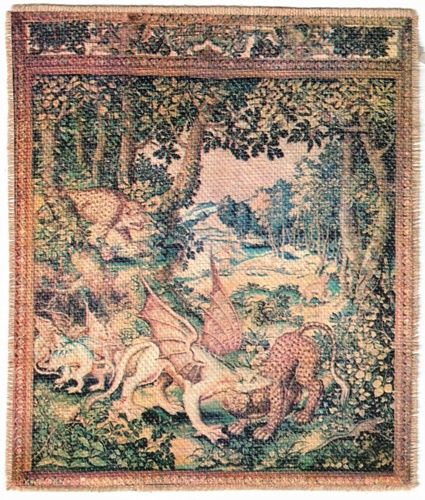
Tapestry with Animals ala1141
$30.00
In stock: 1 available
Save this product for later
Product Details
We think this tapestry came from a castle gift shop.
The story is in another language on the back: see below.
This one is 6 1/2" x 5 1/2" with a fringe on the edge.
Master of Freehand Signage workshop – manufacturer of the orginal.
Artist associated with Pieter Coecke van Aelst – artist / maker.
ca. 1555, Brussels, Belgium.
Wawel Royal Castle – National Art Collection
This is one of the most famous verdure tapestries in the collection of King Sigismund II Augustus. A dragon and a panther fight in a forest clearing. On the left side of the scene, three young dragons crowd together: above them, on an overgrown fallen tree, another panther lurks, possibly hurrying to help the one already fighting. In the bottom right corner, a lizard is standing motionless. Further in the background, by the lake, another predator can be seen, as well as a deer and two fantastic hoofed creatures.
Imaginary animals are not predominant in tapestry presentations. When they sometimes appear, their presence usually has a symbolic meaning. In the tapestry Dragon Fighting against a Panther, their symbolism is derived from Physiologus, an ancient treatise on animals containing, aside from their description, allegorical interpretations of fauna, flora, and minerals. According to the treatise, the panther is loved by all animals, with the exception of the dragon. Traditionally, such a presentation is interpreted as an allegory of Christ’s struggle against Satan. Here, the dragon symbolises forces of evil, while the panther stands for forces of good. Dragon Fighting against a Panther is part of a small group of five large, rectangular verdure tapestries. A wide border (bordure) with mythological deities, festoons, and bouquets of flowers encloses the pictorial field of the tapestry along its upper edge.
Location Guide--Room 2, case 7, Shelf 1
Customer reviews
Reviews only from verified customers
No reviews yet. You can buy this product and be the first to leave a review.
Tapestry with Animals ala1141
Powered by Lightspeed
Display prices in:USD